
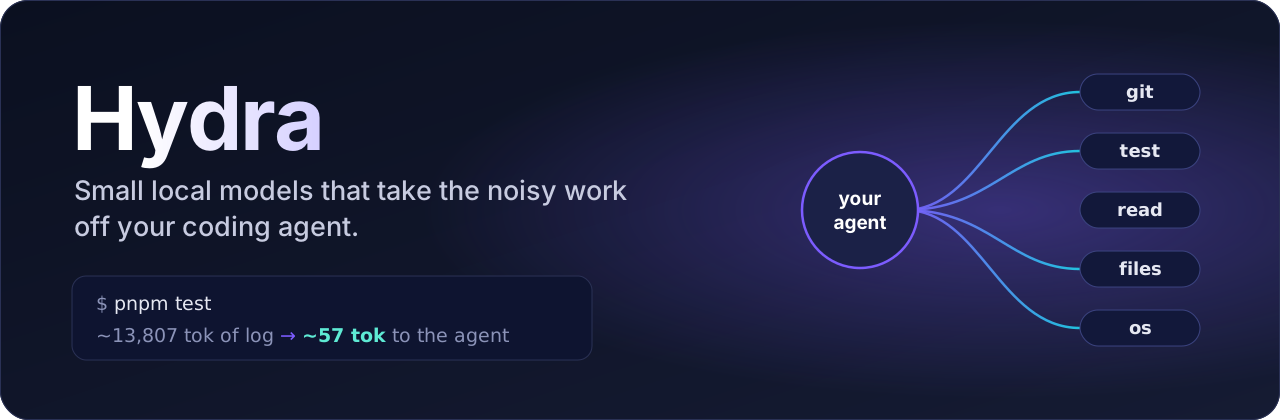


Your coding agent reads every line of every test log, git diff and process list it runs.
Hydra reads them on your machine and hands back only the lines that matter.
Frontier coding agents pay for every token of tool output: a failing test suite, a long git log, a ps dump. Most of it is noise, and all of it fills the context window.
Hydra puts small specialist models on your own machine between the agent and that output:
- Less context, same answer. A
pnpm testrun that printed ~13,807 tokens reached the agent as ~57: the failing test, the assertion diff and the source line. - Nothing leaves your machine. The model runs locally on llama.cpp. Hydra's telemetry stays in
~/.hydra/ledger.jsonl. - Read-only by design. The model never writes a shell command. It picks from fixed, read-only menus; code builds and runs the command.
- Verbatim, not paraphrased. Hydra returns the command's own lines, so the agent sees evidence, not a summary.
npx hydra-nanoOne command installs everything: a pinned llama.cpp runtime, the ~812 MB Hydra Nano model (SHA-256 checked), the Hydra skill, and the integration for each coding tool it finds.
Want the hydra command in your own terminal too?
npm install -g hydra-nano
hydra doctor
Requires Node 18+. Runtime packages for macOS, Linux and Windows on x64 and arm64; verified live on macOS and Windows. Prefer GitHub? npx github:rahul05ranjan/hydra installs the same thing.
| Tool | How Hydra joins | Status |
|---|---|---|
| Claude Code | Skill + hooks that route test/build runs and git questions | Tested |
| Codex | Skill + MCP server + PreToolUse hook |
MCP listed by Codex; trust the hook with /hooks |
| OpenCode | MCP server + plugin | MCP connects |
| Cursor | MCP server + beforeShellExecution hook |
Preview |
| Gemini CLI | MCP server + BeforeTool hook |
Preview |
| Antigravity | Skill + MCP server | Preview |
Any other tool that speaks MCP can use Hydra too: point it at hydra mcp (stdio).
Hydra never overwrites your settings. Every file it edits is backed up once as <file>.before-hydra, only Hydra's own entries change, and hydra agents remove takes them out again.
| Head | Ask it | It returns |
|---|---|---|
| git | "what changed in the last commit?", "who last touched billing.js?" |
The matching commits, diff hunks or blame lines |
| test | hydra run -- npm test (pytest, cargo, go, tsc, gradle, ...) |
Failing test names, assertion diffs and source locations, with the original exit code |
| os | "what is listening on port 3000?" | The matching ports, processes or disk lines, with secrets blocked |
| read | hydra read src/server.ts handleRequest |
One symbol, a line range or an outline |
| files | hydra search parseConfig |
Definition-ranked matches |
Through MCP, Hydra offers the three where it pays most: hydra_git, hydra_run and hydra_os.
Hydra Nano v2: a full-parameter fine-tune of a 0.8B model, one set of weights for every head, run as a Q8_0 GGUF.
| Set | Tasks | Solved |
|---|---|---|
| Git (sealed test set, never used for training) | 1,000 | 96.3% |
| Files (held out) | 1,000 | 98.0% |
| Read (held out) | 1,000 | 96.1% |
| Test logs (second held-out set) | 1,000 | 97.5% |
| OS (held out, synthetic probe outputs) | 1,000 | 100% |
| Test-log benchmark across 8 frameworks | 20 | 19/20, 47% fewer tokens |
Receipts: model card and evals/results.
In real use. Since 2026-10-17, Hydra has handled 118 calls in 9 coding sessions across 3 projects on the maintainer's machine. Of ~375,638 tokens of command output, ~18,781 reached the agent: 95% kept out of context.
| Work | Calls | Output read locally | Reached the agent | Kept out |
|---|---|---|---|---|
| Test and build runs | 112 | ~374,873 | ~18,199 | 95% |
| File slices | 1 | ~508 | ~283 | 44% |
| Git questions | 5 | ~257 | ~299 | -16% |
From Hydra's local ledger; tokens are estimates (characters / 4). Updated 2026-10-20.
Where Hydra does not help, measured. In a controlled trial of 36 Claude Code sessions extracting functions from real source code, forcing that work through Hydra used 72% more tokens than the agent's own tools. So Hydra leaves source reading and search to the agent, and routes only the noisy work: test and build logs, git history, system inspection. Full method and numbers in evaluations.
hydra ask "which branch am I on and what changed?"   # git, files or os, routed by the question
hydra run -- pytest -q                               # a test or build run, digested
hydra os "what is using port 8080?"                  # read-only system inspection
hydra read src/app.py create_app                     # one symbol, a line range or an outline
hydra smell src/                                     # detect Refactoring.Guru code smells (or --diff / --staged)
hydra refactor src/app.py process_order              # actionable step-by-step refactoring recipe
hydra design "need flexible algorithms at runtime"   # GoF design pattern advisor & architecture guide
hydra stats                                          # tokens kept out of context
hydra improve --since 2026-10-17                     # what the local telemetry says to improve
hydra agents status                                  # Hydra in each coding tool
hydra doctor                                         # is the local model ready?
Need the raw log for one run? Prefix it with HYDRA_RAW=1 and the hook lets it through.
- Local only. The model, the runtime and the telemetry live in
~/.hydra. Nothing is sent anywhere. - Turn telemetry off with
HYDRA_TELEMETRY=0. - Skip parts of the install with
--no-agents(no other tools),--no-hooks(no hooks) or--runtime-only(no skill). - Uninstall cleanly.
hydra agents removeandhydra hooks removeundo every integration and restore your settings;hydra stopstops the local server; deleting~/.hydraremoves the runtime, the model and the telemetry.
- How Hydra works: heads, backends (llama.cpp or Ollama), telemetry, every install path and the code layout.
- Evaluations and trials: how each number above was measured.
- What real use teaches: the open and fixed findings from Hydra's own telemetry.
- Hydra Nano on Hugging Face.
MIT. See LICENSE.