
MCCL: Training Pytorch models across a fleet of Macs at Skywalker Sound


MCCL is a torch.distributed backend for Apple-silicon GPUs. Training code selects it
with backend="mccl". It runs multi-node PyTorch over Ethernet. At Skywalker Sound,
MCCL has trained production audio VAEs across as many as 24 Macs. It has also been used
to prototype distributed PyTorch inference for open-weight LLMs with up to 2.8 trillion
parameters.
PyTorch has no distributed backend for MPS tensors, and Gloo accepts only CPU tensors, so a Gloo run copies every gradient bucket to CPU after a device synchronization. MCCL reduces gradients in place in unified memory and uses Metal shared events to order that work against PyTorch's MPS stream, so the allreduce overlaps the backward pass.
Requires an Apple-silicon Mac, macOS 15 or 26, Python 3.11–3.13, and PyTorch 2.13 or 2.14.
pip install torch==2.14.0   # PyPI wheels are built against PyTorch 2.14
pip install mccl
To build from source, install the Xcode Command Line Tools (xcode-select --install), then
run pip install -e ".[dev]" --no-build-isolation in a clone of this repository so the
extension builds against your installed PyTorch.
MCCL now also powers distributed PyTorch pipeline inference for frontier open-weight models on the same 10GbE Mac fleet:
- GLM-5.3-Flash (300B parameters, full 4-bit): 43–48 tok/s for one user on 2 Macs.
- Kimi K2.6 (1.04T parameters): up to 26.8 tok/s for one user on 10 Macs.
- GLM-5.3 (743B parameters, full 4-bit): up to 39.7 tok/s for one user on 6 Macs.
- Kimi K3 (2.8T parameters): served at 2.9 tok/s on 21 Macs as a full-fleet distributed-inference proof.
The interactive-serving figures are warm measurements. Distributed inference is a new direction for MCCL, and these results are an early baseline. We expect throughput to improve as the runtime matures. More details, reproducible inference code, and a technical blog are coming soon.
import torch
import torch.distributed as dist
from torch.nn.parallel import DistributedDataParallel as DDP
import mccl  # registers the "mccl" backend

dist.init_process_group(backend="mccl", device_id=torch.device("mps:0"))
model = DDP(torch.nn.Linear(512, 10).to("mps"))
opt = torch.optim.AdamW(model.parameters(), lr=1e-3)

for step in range(10):
    loss = model(torch.randn(8, 512, device="mps")).square().mean()
    opt.zero_grad()
    loss.backward()
    opt.step()

dist.destroy_process_group()
Test on one Mac with two ranks, then run one rank per Mac with the same MASTER_ADDR and
MASTER_PORT on every node:
torchrun --nproc_per_node=2 --master_addr=127.0.0.1 --master_port=29500 train.py

MCCL_IFNAME=en0 torchrun --nnodes=4 --nproc_per_node=1 --node_rank=$NODE_RANK \
  --master_addr=10.0.0.10 --master_port=29500 train.py
MCCL_IFNAME selects the training interface on Macs with more than one network interface.
The measurements below used these settings on every Mac, with jumbo frames enabled on the switch:
| Setting | Value |
|---|---|
| Interface MTU | 9000 |
kern.ipc.maxsockbuf |
32 MiB |
net.inet.tcp.autorcvbufmax, net.inet.tcp.autosndbufmax |
32 MiB |
kern.ipc.somaxconn |
2048 |
net.inet.tcp.delayed_ack |
0 |
See docs/MULTINODE.md for the multi-node checklist and troubleshooting, and docs/THUNDERBOLT_SETUP.md for Thunderbolt networking.
Measured on 24 Mac Studios at Skywalker Sound (M4 Max, 40-core GPU, 128 GB), one 10 GbE switch, jumbo frames, MCCL 6.8.0, and PyTorch 2.14.
| Measurement | Result |
|---|---|
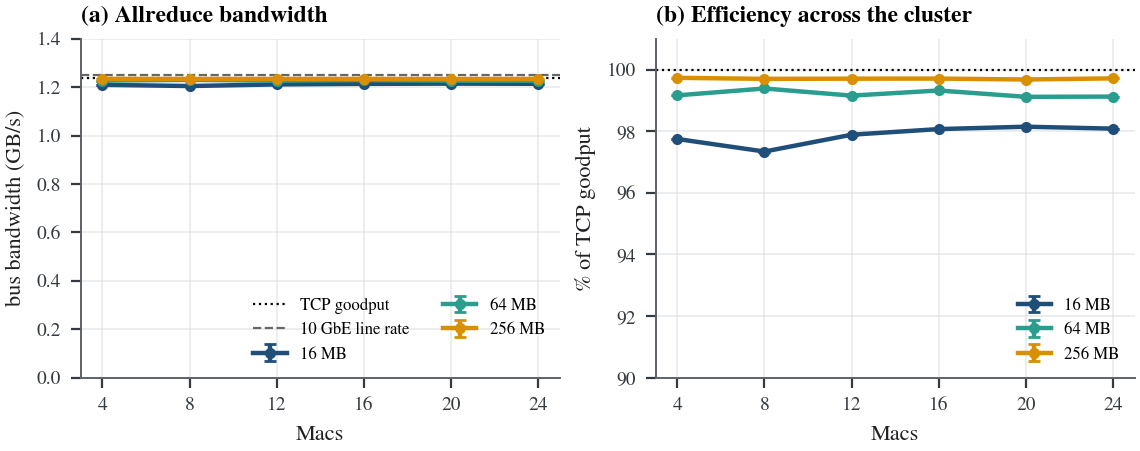
| 256 MB allreduce, 4–24 Macs | 99.7% of TCP goodput at 24 Macs (1.234 GB/s bus bandwidth) |
| Communication hidden behind gradient computation (25 MB buckets) | 94% at 4, 8, 16, and 24 Macs |
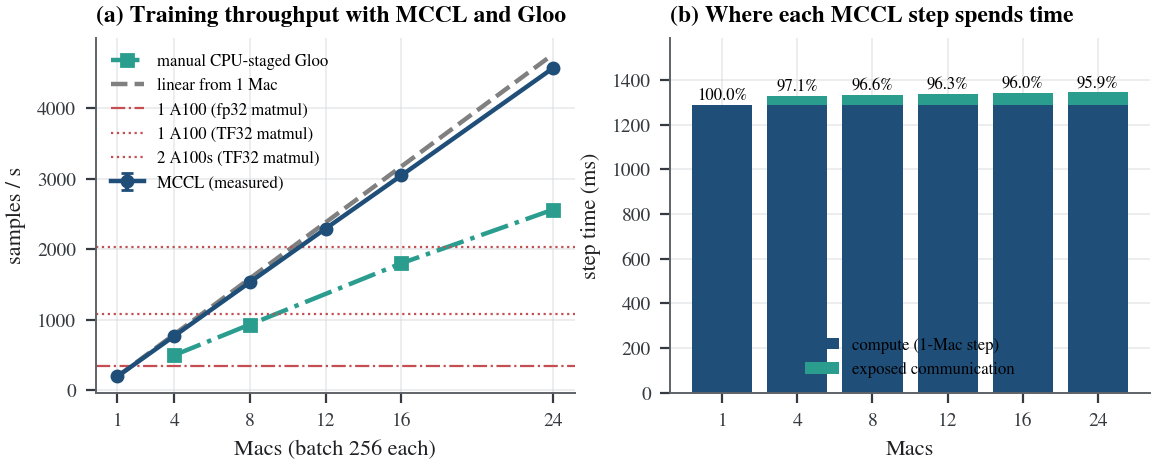
| 113.5M-parameter ViT on CIFAR-10, 1 → 24 Macs | 198 → 4,568 samples/s (95.9% scaling efficiency; 1.78× CPU-staged Gloo) |
| Same ViT on A100 80 GB GPUs | 1,088 samples/s on one GPU and 2,028 on two with TF32 matmul (24 Macs are 2.25× that two-GPU run). One A100 with fp32 matmul reaches 340 samples/s |
| 31.6M-parameter ResNet on CIFAR-10, 400 steps, batch 64 per Mac | 42.0% validation accuracy on 1 Mac, 63.2% on 24 |
| 10-minute soak at 24 Macs | 17,784 allreduces per rank, zero incorrect elements |
| CPU cost at line rate | 0.31 cores |
In-place reduction. On shared MPS storage, MCCL sends from and reduces into each gradient bucket's own Metal buffer using Accelerate, with fp16 and bf16 accumulated in fp32. Gradients are not staged through host memory or copied back to the GPU.
Shared-event ordering. The CPU engine starts on a bucket as soon as its GPU producers finish, and later GPU work waits for the reduced result. MCCL never submits PyTorch's MPS stream or drains the device, which is what allows communication to overlap backward.
sequenceDiagram
    participant PT as PyTorch thread
    participant GPU as MPS stream (GPU)
    participant ENG as MCCL engine (CPU)
    participant NET as Peer Macs
    PT->>GPU: encode backward kernels that write bucket k
    PT->>GPU: encode producer signal k and commit
    GPU-->>ENG: producer event reaches k
    ENG->>NET: ring reduce-scatter and allgather on bucket k, in place
    ENG-->>GPU: CPU sets consumer event to k
    PT->>GPU: encode GPU-side wait on k before the optimizer reads bucket k
    Note over PT,GPU: Only PyTorch's thread submits its stream
TCP transport. Large allreduces use a pipelined reduce-scatter/allgather ring and small ones use recursive doubling. Per-peer reader threads, credit-based flow control, and issue-order admission keep every rank on the same schedule.
Supported collectives: allreduce, broadcast, allgather, reduce_scatter, barrier,
send, and recv.
MCCL runs with its defaults, which are the settings behind the results above. The settings you are most likely to need, set on every rank:
MCCL_IFNAME=en0selects the network interface on Macs with more than one.MCCL_PORT_BASE=20100sets the first listen port (rank r usesbase + r).MCCL_LOG_LEVEL=INFOlogs the selected interface, address, MTU, and link speed at startup.
See docs/CONFIGURATION.md for every setting.
mccl.get_metrics() and mccl.log_metrics() report per-collective counters and latencies,
and python tests/bench_busbw.py measures algorithm and bus bandwidth by message size. CI
builds the extension and runs a two-rank DDP smoke test and an in-flight collectives check.
Locally, pytest tests -m "not slow" runs the broader suite, which launches several ranks
per Mac, withholds implicit GPU synchronization, and checks every output element exactly.
On PyTorch 2.14 and macOS 15.7, the MPS backward pass of reflect padding is exact up to
65,535 samples (2¹⁶ − 1), silently returns wrong gradients above 2¹⁶ samples for single-channel
inputs (except at exact multiples of 2¹⁶), and fails at every length ≥ 2¹⁶ when batch or
channel count exceeds one. Centered torch.stft pads a batch as channels, so spectral
losses on clips longer than about 1.4 s at 48 kHz train on wrong gradients with no error or
NaN. Validate GPU losses against a CPU reference; mccl.transforms.stft(..., backend="vdsp")
is an independent Accelerate implementation suitable for that check.
The in-place path requires shared MPS storage, the PyTorch 2.14 default. Private storage falls back to a staged path.
Paper: MCCL: Training Pytorch models across a fleet of Macs at Skywalker Sound
@misc{sasso2026mccltrainingpytorchmodels,
      title={MCCL: Training Pytorch models across a fleet of Macs at Skywalker Sound},
      author={Kevin Sasso and Chris Fiegel and Francis Aitken and Nicolas Tsingos and Nicholas Tong},
      year={2026},
      eprint={2610.39029},
      archivePrefix={arXiv},
      primaryClass={cs.DC},
      url={https://arxiv.org/abs/2610.39029},
}
Software:
@software{sasso2026mccl,
  author  = {Sasso, Kevin},
  title   = {{MCCL} (Metal Collective Communication Library)},
  year    = {2026},
  version = {6.9.1},
  url     = {https://github.com/mps-ddp/mccl}
}MIT. See LICENSE.