ACM Transactions on Graphics (Proceedings of SIGGRAPH 2026)
Ruihan Yu
·
Yu-Chen Wang
·
Jingwang Ling
·
Feng Xu
·
Shuang Zhao


This repository contains the reference implementation of:
Ruihan Yu, Yu-Chen Wang, Jingwang Ling, Feng Xu, and Shuang Zhao. 2026. Sample Matching for Joint Extinction Gradient Estimation in Differentiable Volume Rendering. ACM Trans. Graph. 45, 4, Article 136 (July 2026), 15 pages. https://doi.org/10.1145/3811329
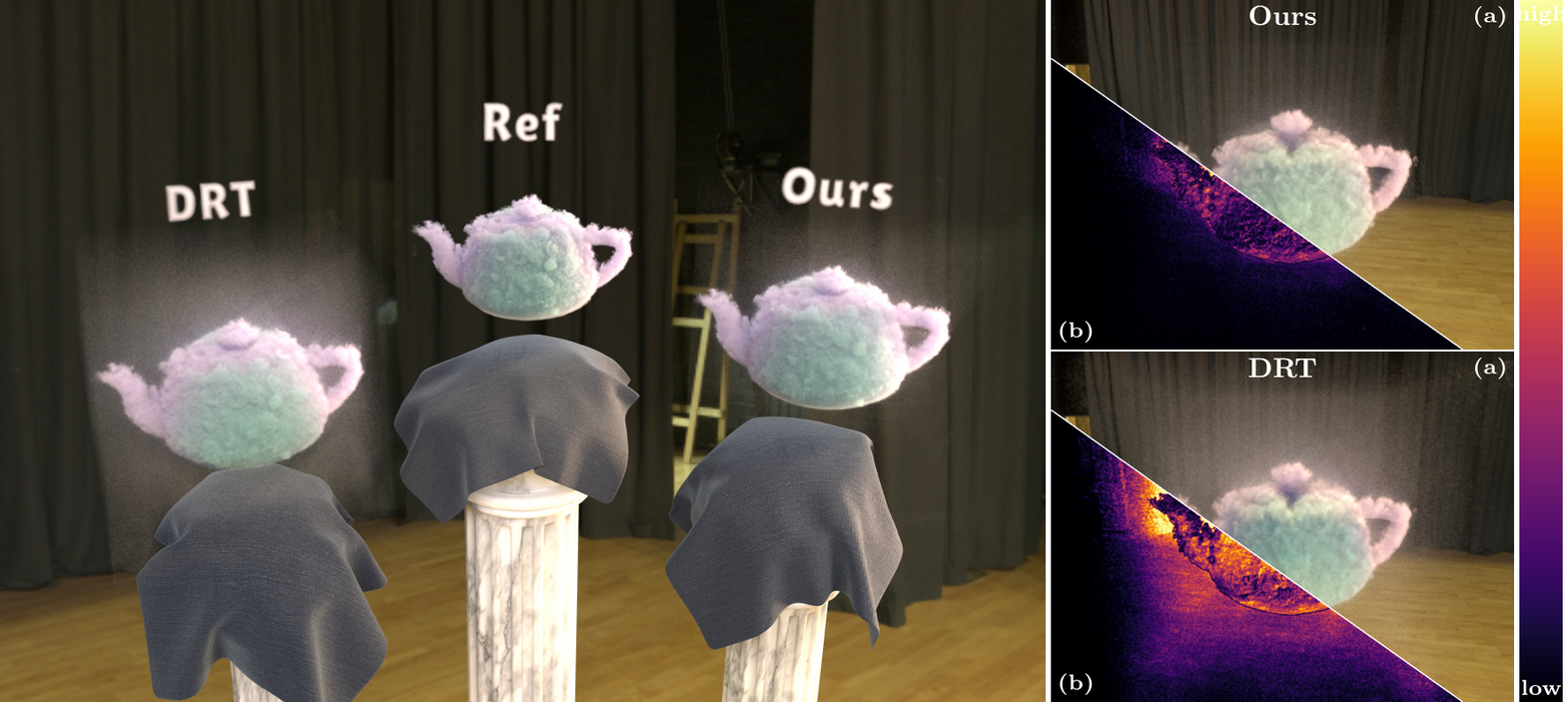
Differentiating the volumetric path integral with respect to the extinction coefficient splits the gradient into a scattering term (evaluated at a path vertex) and a transmittance term (integrated along the ray segment). These two terms have opposite signs and are therefore negatively correlated, but existing estimators sample them at different locations and leave that correlation unexploited. Sample matching evaluates both components at shared sample locations, activating the negative covariance and reducing extinction-gradient variance by up to 80% over differential ratio tracking (DRT), without introducing bias.
The implementation builds on the Mitsuba 3 differentiable renderer and uses differential ratio tracking (Nimier-David et al. 2022) as the baseline.
@article{yu2026samplematching,
    author    = {Yu, Ruihan and Wang, Yu-Chen and Ling, Jingwang and Xu, Feng and Zhao, Shuang},
    title     = {Sample Matching for Joint Extinction Gradient Estimation in Differentiable Volume Rendering},
    journal   = {ACM Transactions on Graphics},
    year      = {2026},
    month     = jul,
    volume    = {45},
    number    = {4},
    articleno = {136},
    numpages  = {15},
    doi       = {10.1145/3811329},
    url       = {https://doi.org/10.1145/3811329},
    publisher = {Association for Computing Machinery},
    address   = {New York, NY, USA},
}
This work builds on the DRT baseline; if you use this code, please also cite:
@article{nimierdavid2022unbiased,
    author    = {Merlin Nimier-David and Thomas M\"uller and Alexander Keller and Wenzel Jakob},
    title     = {Unbiased Inverse Volume Rendering with Differential Trackers},
    journal   = {ACM Trans. Graph.},
    issue_date = {July 2022},
    volume    = {41},
    number    = {4},
    month     = jul,
    year      = {2022},
    pages     = {44:1--44:20},
    articleno = {44},
    numpages  = {20},
    url       = {https://doi.org/10.1145/3528223.3530073},
    doi       = {10.1145/3528223.3530073},
    publisher = {ACM},
    address   = {New York, NY, USA},
    keywords  = {differentiable rendering, inverse rendering, volumetric rendering, radiative backpropagation, importance sampling}
}This code relies on modifications to Mitsuba 3 that live on the
unbiased-inverse-volume-rendering branch (the same branch used by the DRT
baseline). Make sure to check out that branch:
git clone --recursive https://github.com/mitsuba-renderer/mitsuba3 --branch unbiased-inverse-volume-rendering
cd mitsuba3
mkdir build && cd build
cmake -GNinja ..
ninja
Please use the cuda_ad_rgb variant. See the
Mitsuba 3 docs for full build instructions.
Building on a recent toolchain (GCC ≥ 13 / CMake ≥ 4) — click to expand
This is a 2022-era branch (Mitsuba 3.0.0 /
Dr.Jit 0.2.1) and compiles cleanly with a period-appropriate compiler. On a
current Linux system (e.g. GCC >= 13, CMake >= 4) the plain cmake .. && ninja
above fails. The following recipe was verified on GCC 16 / CMake 4;
it installs a 2022-era compiler into a conda env and points CMake at it:
conda create -n samplematching python=3.10 -y
conda install -n samplematching -c conda-forge gcc_linux-64=12 gxx_linux-64=12 zlib -y
CONDA=$(conda info --base)/envs/samplematching
export CMAKE_POLICY_VERSION_MINIMUM=3.5            # bundled submodules predate CMake 3.5
export CPATH=$CONDA/include LIBRARY_PATH=$CONDA/lib
cmake -GNinja \
    -DCMAKE_C_COMPILER=$CONDA/bin/x86_64-conda-linux-gnu-gcc \
    -DCMAKE_CXX_COMPILER=$CONDA/bin/x86_64-conda-linux-gnu-g++ \
    -DPython_EXECUTABLE=$CONDA/bin/python \
    -DCMAKE_POLICY_VERSION_MINIMUM=3.5 \
    -DCMAKE_CXX_FLAGS="-include cstdint -include limits -include algorithm -include cstring" \
    -DCMAKE_EXE_LINKER_FLAGS="-L$CONDA/lib -Wl,-rpath-link,$CONDA/lib -Wl,-rpath,$CONDA/lib" \
    -DCMAKE_SHARED_LINKER_FLAGS="-L$CONDA/lib -Wl,-rpath-link,$CONDA/lib -Wl,-rpath,$CONDA/lib" \
    -DCMAKE_MODULE_LINKER_FLAGS="-L$CONDA/lib -Wl,-rpath-link,$CONDA/lib -Wl,-rpath,$CONDA/lib" \
    ..
ninja
One source patch is also needed: in ext/drjit/include/drjit/packet_intrin.h,
define _X86GPRINTRIN_H_INCLUDED next to the existing _IMMINTRIN_H_INCLUDED
(GCC >= 11 moved the BMI intrinsics behind a new include guard). The -include
flags work around headers that newer libstdc++ no longer pulls in transitively
(e.g. std::numeric_limits); the linker flags resolve libatomic for the
mitsuba CLI. To build only what you need, set "enabled" to
["scalar_rgb", "cuda_ad_rgb"] in build/mitsuba.conf and re-run cmake.
cuda_ad_rgb runs unmodified on recent GPUs: Dr.Jit emits sm_60 PTX that
the driver re-JITs for the installed device.
git clone https://github.com/AuroraRyan0301/SampleMatching.git
cd SampleMatching
pip install -r requirements.txt
Make the Mitsuba 3 libraries available in your session before running anything:
source ../mitsuba3/build/setpath.sh
python3 -c "import mitsuba as mi; mi.set_variant('cuda_ad_rgb')" # should run without outputScene files (XML configs, .vol grids, meshes, environment maps) and the
multi-view reference images are hosted on Hugging Face. Download and unpack them
into a top-level data/ directory:
hf download AuroraRyan/sample-matching-data posttracking_data.tar.gz \
    --repo-type dataset --local-dir .
mkdir -p data && tar -xzf posttracking_data.tar.gz -C data
The expected layout (see python/constants.py) is:
data/
├── scenes/            scene XMLs + .vol grids + textures (one dir per scene, plus common/)
└── mi_ref/<scene>/    multi-view reference images (ref_XXXXXX.exr)
You can also point POSTTRACKING_DATA_DIR at any other location instead of
data/.
All experiments are driven by python/reproduce.py. List the available
configurations:
python3 python/reproduce.py --listRun one scene with all four methods, or a single method:
# all four standard methods on bunny-cloud
python3 python/reproduce.py --config bunny-cloud-l1-6e-3-formal-local-single-gpu

# a single method
python3 python/reproduce.py --config bunny-cloud-l1-6e-3-formal-local-single-gpu \
        --integrator volpathfm-drt-sd-n4
Outputs (checkpoints, preview renders, PSNR logs) are written to output/
(override with POSTTRACKING_OUTPUT_DIR). Pass --log to enable optional
Weights & Biases logging.
Once a run has finished, build a side-by-side comparison figure from its preview
renders. datagen/make_fig.py reads the preview .exr files from
output/<config>/<method>/, tonemaps them to sRGB, and lays out
[reference | initial | each method's final render] for one view, annotating each
cell with its PSNR against the reference:
python datagen/make_fig.py --config bunny-cloud-l1-6e-3-formal-local-single-gpu --view 0The result on a held-out test view of bunny-cloud — Sample Matching ("ours")
reaches a higher PSNR than the DRT baseline in both the quadratic and linear cost
regimes:

Each formal experiment compares the DRT baseline against our method, each in a quadratic-cost and a linear-cost variant:
Config (--integrator) |
Integrator plugin | Method | Cost |
|---|---|---|---|
volpathsimple-drt-mis-n4 |
volpathsimple |
DRT (baseline) | quadratic |
volpathsimple-drt-mis-linear |
volpathsimple |
DRT (baseline) | linear |
volpathfm-drt-sd-n4 |
volpathfm_sd |
ours | quadratic |
volpathfm-linear-drt-sd-n4 |
volpathfm_linear_sd |
ours | linear |
See python/opt_config.py for the full set of integrator variants and their
options.
bunny-cloud, astronaut-rotated, jellyfish, teapot, scarf, rover,
dragon_media2, dust-devil. Per-scene hyper-parameters (learning rate,
multi-resolution upsampling schedule, sensors) are defined in
python/scene_config.py and python/reproduce.py.
python/
├── reproduce.py            experiment entry point (configs for the 8 paper scenes)
├── optimize.py             optimization loop: rendering, loss, Adam, upsampling, checkpoints, previews
├── scene_config.py         per-scene definitions (XMLs, init values, sensors, reference config)
├── opt_config.py           optimization & integrator configurations
├── batched.py              batched multi-sensor rendering (render_batch)
├── losses.py               loss functions (L1, L2, Huber, MRAE, ...)
├── util.py                 helpers (volume I/O, checkpoint saving, PSNR, tonemapping)
├── constants.py            data/output path configuration (env-overridable)
├── relighting_render.py            (optional) re-render reconstructions under a new envmap
├── calculate_relighting_psnr.py    (optional) HDR quality metrics (PSNR / SSIM / LPIPS)
└── integrators/
    ├── volpathsimple.py            baseline: differential ratio tracking (Nimier-David et al. 2022)
    ├── volpathfm_sd.py             ours: sample matching, quadratic O(n^2)
    ├── volpathfm_linear_sd.py      ours: sample matching, linear O(n)
    └── volpathsimple_no_bg.py      forward-only integrator for background-free previews
datagen/
├── gen_sensors.py / sensor_gen.py / gen_vol.py / render.py / upsampling.py   scene/sensor/volume generation
└── make_fig.py             build the README method-comparison figure from a run's previews
This codebase builds on the 2022 "Unbiased Inverse Volume Rendering" code of Nimier-David et al. and inherits its constraints: it is pinned to a specific, older Mitsuba 3 branch, contains a number of bugs, and is not easy to maintain. We provide it here so the paper's results can be reproduced as-is.
We plan to release a cleaner reimplementation targeting the latest Mitsuba 3 in the future.
This project builds directly on Unbiased Inverse Volume Rendering with Differential Trackers (Nimier-David, Müller, Keller, Jakob; SIGGRAPH 2022), whose code provides the DRT baseline and the experiment framework, and uses the Mitsuba 3 renderer.
The environment maps and fabric used in the teaser were provided by PolyHaven; the marble pillar in the teaser is from Sketchfab by Louqeekon.
Released under the BSD 3-Clause License. If you use this code in academic research, please cite the paper above.