IEEE Transactions on Visualization and Computer Graphics (TVCG) 2025
Ruihan Yu*
·
Tianyu Huang*
·
Jingwang Ling
·
Feng Xu†
* Equal contribution · † Corresponding author · Tsinghua University


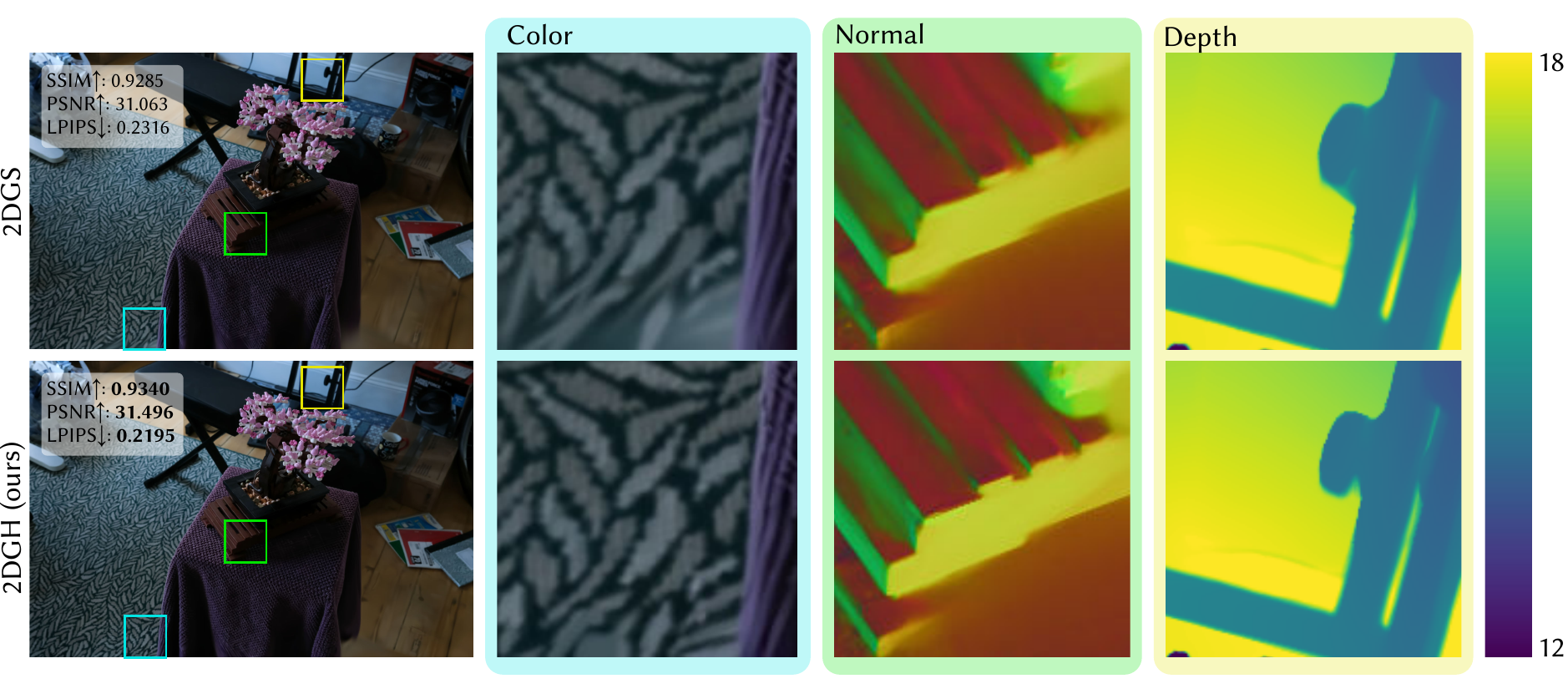
2DGH replaces the Gaussian primitive of 2D Gaussian Splatting (2DGS) with a Gaussian-Hermite (GH) kernel — a Gaussian modulated by a Hermite-polynomial series. Inspired by the higher-rank wavefunctions of the quantum harmonic oscillator, the GH kernel is a unified family in which the standard Gaussian is the rank-0 special case; higher ranks add anisotropy and deformation power, sharpening object silhouettes and recovering fine, non-Gaussian detail. A dedicated activation keeps the alpha-blended opacity within [0, 1] even with the large or negative high-order coefficients. This repository contains the training, rendering and evaluation code, and reproduces the comparison between three rasterizers:
| Method | Flag | Rasterizer kernel |
|---|---|---|
original |
--use_original_rasterizer |
diff-surfel-rasterization-original |
ges |
--use_ges_rasterizer |
diff-ges-surfel-rasterization |
gh |
--use_gh_rasterizer |
diff_gh_surfel_rasterization |
The code is tested with Python 3.8, PyTorch 2.4, and a CUDA 11.8 / 12.1 toolkit on an NVIDIA RTX 4090 (compute capability 8.9).
The CUDA rasterizers and simple-knn are git submodules, so clone recursively:
git clone --recursive https://github.com/AuroraRyan0301/2DGH.git
cd 2DGH
# If you already cloned without --recursive:
git submodule update --init --recursive| Submodule path | Purpose |
|---|---|
submodules/diff_gh_surfel_rasterization |
GH rasterizer (this paper) |
submodules/diff-ges-surfel-rasterization |
GES rasterizer baseline |
submodules/diff-surfel-rasterization-original |
original 2DGS rasterizer |
submodules/simple-knn |
KNN for point initialization |
conda create -n 2dgh python=3.8.18
conda activate 2dgh
Install PyTorch matching your CUDA toolkit. For CUDA 12.x:
pip install torch==2.4.0 torchvision==0.19.0 torchaudio==2.4.0 \
    --index-url https://download.pytorch.org/whl/cu121
(For CUDA 11.8, use --index-url https://download.pytorch.org/whl/cu118.)
The CUDA kernels need the GLM headers. glm.sh clones
the correct GLM revision and copies it into each rasterizer's third_party/:
bash glm.shexport CUDA_HOME=/usr/local/cuda
export TORCH_CUDA_ARCH_LIST="8.9" # set to your GPU's compute capability
pip install -r requirements.txtrequirements.txt installs pytorch3d, chamfer_distance, and the four local
submodules in editable mode. pytorch3d is compiled from source, so make sure
CUDA_HOME matches the toolkit your PyTorch build was compiled against. Building the
CUDA kernels takes several minutes.
python -c "from diff_gh_surfel_rasterization import GaussianGHRasterizer; \
           from diff_ges_surfel_rasterization import GES2DRasterizer; \
           from diff_surfel_rasterization_original import OriginalGaussianRasterizer; \
from simple_knn._C import distCUDA2; print('rasterizers OK')"| Dataset | Link |
|---|---|
| Synthetic NeRF | python down.py (Blender scenes with object GT meshes) |
| Detail | Hugging Face |
| Mip-NeRF 360 | project page |
| DTU | DTU Robot Image Data |
The Detail dataset (high-frequency synthetic scenes used in the paper) is hosted on Hugging Face:
pip install huggingface_hub
huggingface-cli download AuroraRyan2/Detail --repo-type dataset --local-dir data/Detail
After downloading, point the dataset paths in the scripts under my_scripts/ and
eval_scripts/ to your dataset locations.
# Train (choose one rasterizer flag)
python train.py -s <scene> -m <output_dir> --use_gh_rasterizer --hg_opt_flag \
    --white_background --lambda_dist 100

# Render / extract mesh
python render.py -s <scene> -m <output_dir> --use_gh_rasterizer --hg_opt_flag --eval

# Metrics (PSNR/SSIM/LPIPS) and Chamfer distance
python metrics.py -m <output_dir>
Reproduction scripts (edit the dataset paths inside first):
bash my_scripts/nvs/ns_nvs.sh                # novel-view synthesis, Synthetic NeRF
bash my_scripts/nvs/m360_nvs.sh              # novel-view synthesis, Mip-NeRF 360
bash my_scripts/rendering/ns_rendering_qualtiy.sh
bash my_scripts/rendering/dtu_rendering_quality.sh
bash my_scripts/overhead/overhead.sh
bash my_scripts/ablation/rank_ablation.sh # GH rank ablationThe GH coefficients --max_gh_rank controls
how many ranks are active, progressively enabling coefficients:
--max_gh_rank |
active coeffs | Hermite terms |
|---|---|---|
| 0 (baseline) | 0 | Gaussian only (rank-0) |
| 1 | 1 | constant |
| 2 | 4 | up to rank 1 (dx, dy, dx·dy) |
| 3 | 9 | up to rank 2 (full 3×3 arrangement) |
my_scripts/ablation/rank_ablation.sh sweeps these ranks; the rank-0 baseline freezes the
constant (--max_gh_rank 1 --gh_lr 0), i.e. original 2DGS plus the GH activation.
form.py aggregates per-scene and mean metrics (CD, #Gaussians, model size, PSNR, SSIM,
LPIPS) for a dataset/comparison and prints them as tables:
python form.py --config ns          # Synthetic NeRF comparison
python form.py --config detail      # Detail comparison
python form.py --config ablation    # GH rank ablation
python form.py --config detail --grand-path /your/output/detail_nvs@article{yu2025gaussianhermite,
title = {2DGH: 2D Gaussian-Hermite Splatting for High-quality Rendering
and Better Geometry Features},
author = {Yu, Ruihan and Huang, Tianyu and Ling, Jingwang and Xu, Feng},
journal = {IEEE Transactions on Visualization and Computer Graphics},
year = {2025}
}This code builds on 2D Gaussian Splatting.
See LICENSE.md for license terms (non-commercial research use).